
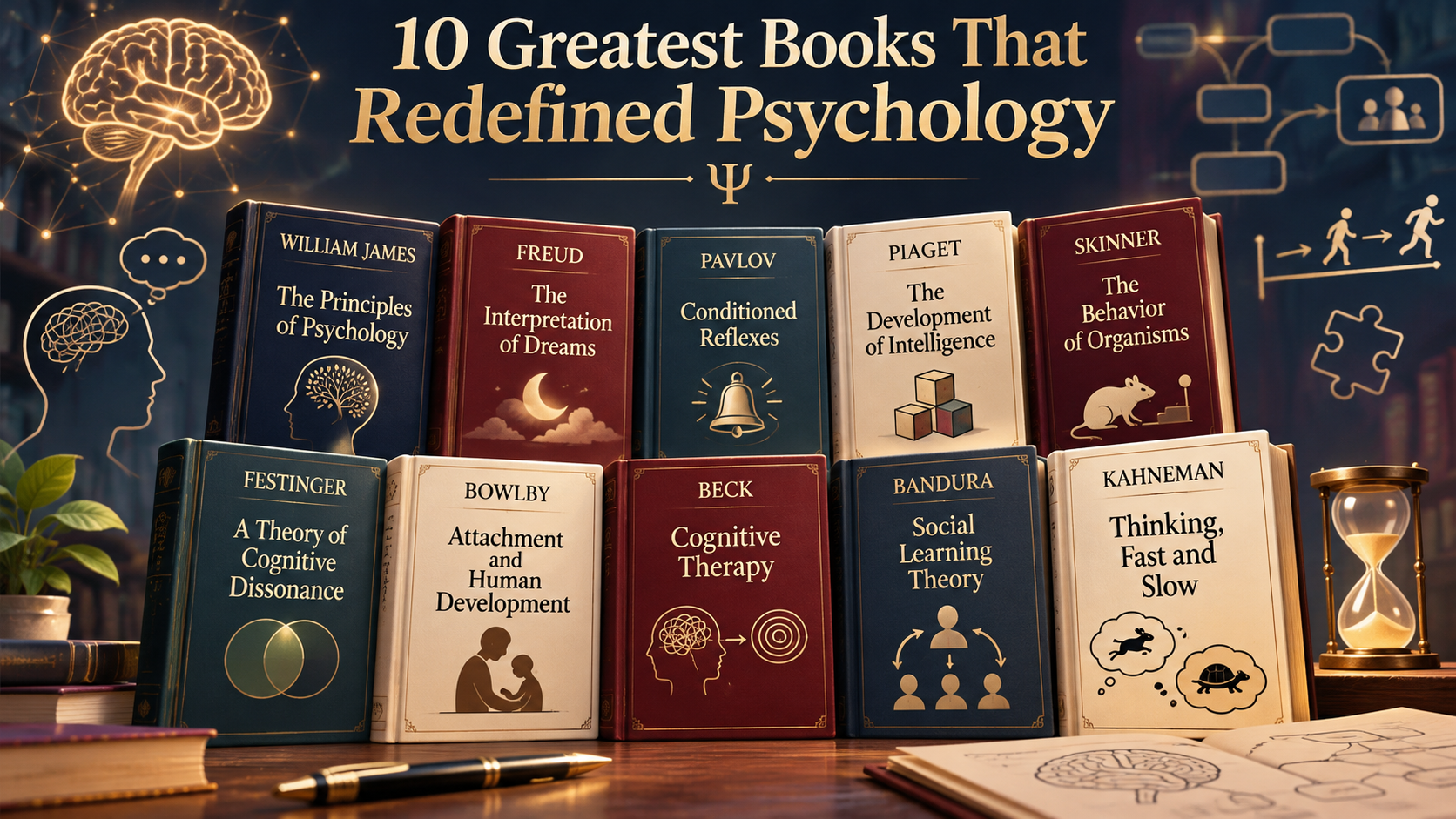
10 Greatest Books That Redefined Psychology
Psychology did not emerge from a single discovery. Its history is a series of arguments about what counts as evidence, what drives human behaviour, how children acquire knowledge, and why people sometimes act against their own interests. Some books changed research methods; others changed therapy, education, or the way ordinary readers describe their minds.
The ten books below are not ranked by sales, popularity, or present-day scientific accuracy. They were chosen for their historical influence and for representing different turning points in psychological thought. Several contain claims that have since been challenged. A book can be revolutionary without being entirely correct.
At a glance
| Book | Author | First publication | Defining contribution |
|---|---|---|---|
| The Principles of Psychology | William James | 1890 | Psychology of attention, habit and consciousness |
| The Interpretation of Dreams | Sigmund Freud | 1900 (title-page date) | Psychoanalytic interpretation of mental life |
| Conditioned Reflexes | Ivan Pavlov | 1927 (English edition) | Experimental study of associative learning |
| The Origins of Intelligence in Children | Jean Piaget | 1936 (French); 1952 (English) | Cognitive development through active exploration |
| Science and Human Behavior | B. F. Skinner | 1953 | Consequences and the shaping of behaviour |
| A Theory of Cognitive Dissonance | Leon Festinger | 1957 | Tension between inconsistent beliefs and actions |
| Attachment and Loss, Vol. 1: Attachment | John Bowlby | 1969 | Emotional bonds as a developmental system |
| Cognitive Therapy and the Emotional Disorders | Aaron T. Beck | 1976 | Role of thoughts in emotional disorders and therapy |
| Social Learning Theory | Albert Bandura | 1977 | Learning through observing others |
| Thinking, Fast and Slow | Daniel Kahneman | 2011 | Cognitive biases and judgment under uncertainty |
1. The Principles of Psychology — William James (1890)
What changed: James helped establish psychology as a serious inquiry into the workings of the mind while resisting an overly mechanical account of human experience.
Across two volumes, James examined attention, emotion, memory, perception, habit and the changing flow of conscious experience. He treated the mind not as a cabinet full of separate objects but as an active process. His discussion of habit also showed how repeated actions could become part of everyday behaviour without constant conscious deliberation.
Why it still matters: Modern research into attention, emotion and learned routines continues to ask questions that James formulated with unusual clarity. His work also reminds us that careful description of experience can generate hypotheses, even when the experimental tools of an era are limited.
Read critically: James combined observation, philosophy and early scientific research. His explanations should not all be treated as contemporary experimental findings.
2. The Interpretation of Dreams — Sigmund Freud (1900)
What changed: Freud argued that apparently meaningless mental experiences might reveal hidden conflicts, wishes and associations.
Dream interpretation became an entry point into psychoanalysis: a framework in which unconscious processes, personal history and psychological conflict could help explain behaviour. The book reshaped clinical conversation and influenced literature, film and cultural accounts of the self.
Why it still matters: Freud made the inner life a topic of sustained public and clinical attention. The idea that people are not fully aware of every influence on their behaviour remains important, although contemporary research studies nonconscious processing using very different methods.
Read critically: Freud's specific theory of dreams as disguised wish fulfilment and many symbolic interpretations are not accepted as established scientific explanations. Its place on this list reflects historical influence rather than validation of its central claims.
3. Conditioned Reflexes — Ivan Pavlov (1927)
What changed: Pavlov demonstrated that the response to a biologically important event could become associated with a previously neutral signal.
In controlled animal experiments, responses such as salivation could be studied through repeated pairings of stimuli. The resulting approach helped researchers describe acquisition, extinction, discrimination and generalisation of learned responses with measurable procedures.
Why it still matters: Classical conditioning became a foundation of experimental learning research and contributed to later behavioural accounts of fear and treatment methods involving exposure. It showed that aspects of learning can be observed without relying only on introspection.
Read critically: Associative learning is one important part of psychology, not a complete account of language, reasoning, identity or complex social life.
4. The Origins of Intelligence in Children — Jean Piaget (1936; English translation 1952)
What changed: Piaget portrayed children as active builders of knowledge, not simply miniature adults with less information.
Observing early development, he described how infants learn through action and exploration. Concepts such as assimilation and accommodation offered a vocabulary for the ways new experience interacts with existing mental structures.
Why it still matters: The book helped make developmental psychology central to education and cognitive research. It encouraged researchers and teachers to ask what a child can understand at a particular point in development—and how that understanding changes.
Read critically: Piaget's observations were influential but based in part on small, selective samples. Later studies have revised the age at which some abilities emerge and questioned rigid interpretations of developmental stages.
5. Science and Human Behavior — B. F. Skinner (1953)
What changed: Skinner gave a systematic account of how consequences can strengthen or weaken patterns of behaviour.
His approach centred on operant conditioning: actions can become more or less likely depending on reinforcement and other consequences. The book applied behavioural principles far beyond the laboratory—to education, social institutions and everyday conduct.
Why it still matters: Behaviour analysis contributed to practical approaches for teaching skills, studying habits and changing behaviour. It also pushed psychology to define observations and outcomes more precisely.
Read critically: Skinner's broad explanations can understate the roles of interpretation, biology, personal agency and cultural context. Behavioural methods require ethical safeguards, particularly when applied to vulnerable groups.
6. A Theory of Cognitive Dissonance — Leon Festinger (1957)
What changed: Festinger proposed that people experience psychological tension when important beliefs, attitudes or actions conflict.
Imagine someone who values health but continues a habit they consider harmful. They might change their behaviour, revise their beliefs or construct explanations that make the mismatch feel smaller. Dissonance theory offered experimentally testable questions about rationalisation, attitude change and self-justification.
Why it still matters: The framework shaped social psychology and helps explain why additional information does not always change a person's mind. It influenced research into choices, persuasion, group identity and post-decision justification.
Read critically: Not every inconsistency produces dissonance, and modern research has debated which psychological mechanisms best account for particular findings.
7. Attachment and Loss, Volume 1: Attachment — John Bowlby (1969)
What changed: Bowlby argued that children's bonds with caregivers are not merely secondary to feeding; they form a biologically meaningful system connected with safety and exploration.
Attachment theory linked ethology, development and clinical observations. A dependable caregiver can serve as a secure base from which a child explores the world, while separations and disruptions can influence emotional responses.
Why it still matters: The book transformed developmental research and informed thinking about early caregiving, separation, family relationships and later social bonds. It opened a long-running research programme rather than providing a final account of every relationship.
Read critically: Attachment patterns are not destiny. Experiences vary with caregiving networks, context and culture; simplistic labels about parents or children can be misleading.
8. Cognitive Therapy and the Emotional Disorders — Aaron T. Beck (1976)
What changed: Beck made patterns of interpretation and automatic thoughts central targets of structured psychotherapy.
Rather than treating emotional suffering only as the expression of deep hidden conflict, cognitive therapy asked how a person's interpretations, expectations and beliefs might interact with emotions and behaviour. The book outlined a practical clinical framework that influenced the development of cognitive behavioural therapy (CBT).
Why it still matters: Cognitive and cognitive-behavioural interventions became major evidence-based approaches for several mental-health conditions. The book helped shift clinical practice toward explicit treatment models and outcomes that could be evaluated.
Read critically: No single therapy works equally well for everyone. Modern CBT encompasses many methods, and treatment must account for severity, circumstances, patient preference and professional assessment.
9. Social Learning Theory — Albert Bandura (1977)
What changed: Bandura showed that learning is not restricted to direct rewards and punishments: people also learn by observing others.
His account emphasised modelling, expectations, attention and self-regulation. Someone may acquire a behaviour from a parent, peer, teacher or media figure without personally experiencing the consequences first.
Why it still matters: Observational learning has shaped work in education, parenting, social behaviour, health communication and media research. It helped restore cognition and social context to models of learning.
Read critically: Observing a behaviour does not guarantee performing it. Motivation, opportunity, individual differences and the surrounding environment matter.
10. Thinking, Fast and Slow — Daniel Kahneman (2011)
What changed: Kahneman brought decades of research on judgment and decision-making to a broad audience through the memorable contrast between fast, intuitive thinking and slower, effortful reasoning.
The book explains heuristics and biases—including the availability heuristic, framing effects and loss aversion—and shows how confidence can exceed accuracy. It connected psychology with economics, policy and everyday decision-making.
Why it still matters: It gave readers a practical language for asking whether a judgment is being driven by an easy impression or by careful evaluation. Its influence extends to behavioural economics, medicine, finance and public policy.
Read critically: The two-system distinction is a useful explanatory framework, not a literal map of two separate brain systems. Some studies discussed in the book, especially in social priming, later faced replication problems; Kahneman publicly acknowledged the need to reassess such evidence.
What these books collectively changed
| Earlier question | New direction encouraged by these books |
|---|---|
| What is consciousness? | Investigate attention, experience and habit systematically |
| Are actions driven by hidden motives? | Examine mental processes beyond immediate awareness, while testing claims critically |
| How do we learn? | Study associations, consequences and observation |
| How does thinking develop? | Follow cognitive change from infancy onward |
| Why do beliefs and actions conflict? | Experimentally study attitude change and rationalisation |
| Why do relationships matter? | Investigate attachment and developmental context |
| Can thinking patterns be changed? | Develop and evaluate structured psychotherapies |
| Are humans rational decision-makers? | Measure biases and the limits of intuition |
The broader story is not a march from one completely correct theory to the next. Psychology advanced as competing explanations forced researchers to invent better questions, measurements and interventions. The most valuable way to read these classics is to ask two things at once: What did this author make possible? and Which claims have survived later testing?
Which should you read first?
- For understanding decisions and biases: Start with Thinking, Fast and Slow, but read it alongside newer criticism and replication research.
- For psychotherapy and clinical thinking: Try Beck's Cognitive Therapy and the Emotional Disorders.
- For child development and relationships: Read Piaget and Bowlby together; they address different dimensions of development.
- For learning and behaviour: Compare Pavlov, Skinner and Bandura to see how conditioning, consequences and observation differ.
- For the history of psychological ideas: Read James and Freud as landmark historical texts, without assuming that influence equals scientific confirmation.
Sources and further reading
These references identify editions, historical context or important scientific qualifications. They are not substitutes for reading the original works.
- York University — Classics in the History of Psychology — historical works and texts.
- York University — Pavlov, Conditioned Reflexes (1927) — original work.
- A History of Modern Psychology — historical context for William James and other early figures.
- Brain — On the scientific status of Freud — critical evaluation of Freud's legacy.
- Indiana University Libraries — Piaget, The Origins of Intelligence in Children — English edition bibliographic record.
- Publisher — Skinner, Science and Human Behavior.
- Stanford University Press — Festinger, A Theory of Cognitive Dissonance.
- Bibliographic record — Bowlby, Attachment and Loss, Volume 1.
- Beck Institute — Publications by Aaron T. Beck.
- National Library of Medicine — Bandura, Social Learning Theory.
- Publisher — Kahneman, Thinking, Fast and Slow.
- UNSW Sydney — Daniel Kahneman on priming and replication.
Editorial note: This is a curated historical selection, not an objective top-ten ranking. Publication years refer to first editions or explicitly identified English editions.