
15 Small Business Ideas You Can Start in India Without a Large Investment
Starting a business does not necessarily require renting a shop, hiring a team or buying expensive machinery. Many practical ventures can begin as small experiments: one paying customer, one useful service and one clear problem to solve. The challenge is not finding an exciting idea; it is discovering whether people will pay for it repeatedly.
This guide examines 15 options that can be tested on a modest budget in India. It focuses on skills, customers, first steps and risks rather than promising quick profits. Costs vary widely by city, equipment you already own, licensing requirements and the scale of operations.
How to Choose an Idea Before Spending Money
Ask four questions: Who has the problem? How are they solving it now? Why would they choose you? What is the smallest paid version you can deliver this month? Speak to prospective customers before buying stock or paying for advertisements. Make a simple budget covering initial equipment, recurring expenses, taxes, marketing, delivery and an emergency reserve.
15 Business Ideas Worth Testing
1. Websites for Local Businesses
Offer a clear, mobile-friendly website with contact details, opening hours, service descriptions and a map to local clinics, tutors, restaurants or repair shops. Start with one portfolio example and a fixed-scope package. Skills: basic web design, hosting, communication and maintenance. Watch out for ongoing support obligations and expensive custom requests.
2. Social Media Content for Small Shops
Local businesses often need product photographs, captions, reels and regular updates. Begin with an agreed calendar and a small pilot. Skills: photography, editing, copywriting and reporting. Avoid guaranteeing follower growth or sales: platform algorithms and customer demand are outside your control.
3. Regional-Language Study Materials
Produce original notes, practice questions, diagrams or explanations in Hindi or another regional language. Test one narrow subject with students and teachers. Skills: domain knowledge, pedagogy, editing and copyright awareness. Check accuracy and do not copy commercial textbooks or exam questions without permission.
4. Digital Templates and Printable Resources
Sell budgeting templates, checklists, presentation designs, revision planners or original business forms. Start with a specific buyer and a demonstrably useful sample. Skills: spreadsheets or design. Challenges include piracy, customer support and low differentiation.
5. Print-on-Demand Merchandise
Create original designs for notebooks, shirts, mugs or stationery and use an external fulfilment provider where appropriate. The appeal is that you can test designs without holding large inventories. But print quality, delivery time, returns and margins must be checked with sample orders.
6. Product Photography and Short Videos
A phone, careful lighting and basic editing may be sufficient to produce useful catalogue photographs for local sellers. Offer a limited number of products per shoot. Skills: framing, lighting and basic video editing. Build consent and intellectual-property permissions into your agreement.
7. Tutoring and Skill Workshops
Teach a skill you genuinely know: spoken English, spreadsheet basics, coding fundamentals, writing or school subjects. Start with a small class, defined learning goals and honest outcomes. Check local rules for operating a coaching business and never promise exam success.
8. Home-Based Custom Gifts
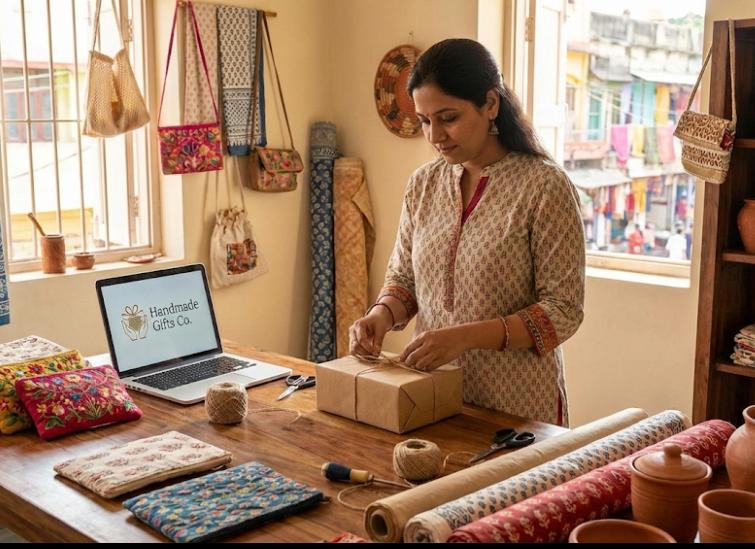
Make personalised stationery, gift hampers, hand lettering or event favours. Take deposits for customised orders where lawful, and confirm delivery dates in writing. Test unit economics carefully: packaging, breakage and festival-driven demand can make profits unpredictable.
9. Local Home-Service Coordination
Help customers identify and schedule vetted cleaners, electricians, plumbers or appliance-repair technicians. This is a trust and operations business rather than just a booking website. Verify providers, agree on responsibilities and maintain a clear complaint process. Safety and service liability matter.
10. Niche Online Store
Rather than selling everything, curate a small catalogue for a defined audience: hobby supplies, educational aids, specialty stationery or locally made goods. Begin with limited inventory and track returns and fulfilment costs. Supplier quality and cash tied up in stock are key risks.
11. Bookkeeping and Spreadsheet Setup
Help small proprietors organise invoices, inventory records, cash-flow summaries and expense spreadsheets. Be precise about your competence: regulated tax, audit or legal advice requires appropriate professionals. Protect client financial information.
12. Translation, Subtitling and Localization
Translate menus, training material, website pages or educational videos for local audiences. A successful service requires proofreading and subject knowledge, not just automatic translation. Sensitive medical or legal materials should receive qualified review.
13. Simple Workflow Automation
Set up appointment reminders, form-to-spreadsheet workflows, standard email responses and lightweight dashboards using approved software. Focus on one repetitive customer task. Obtain permission before accessing customer accounts or personal data, and plan for maintenance if integrations break.
14. Indoor Plants and Plant-Care Services
Sell a small selection of plants or offer maintenance to homes and offices. Start by testing demand with local buyers. Understand plant care, seasonal losses, transport damage and whether any local trading rules apply. Unsold or dying stock can rapidly erase margins.
15. Home-Based Food Products
A limited menu of baked goods, snacks or speciality foods may be attractive where demand exists. However, food safety is non-negotiable: confirm applicable FSSAI registration/licensing, hygiene rules, labelling and delivery requirements before selling. Ingredient costs and spoilage must be counted, not guessed.
Compare the Business Models
| Idea | Main Skill | Common Cost Driver | Important Risk |
|---|---|---|---|
| Local websites | Web design and client management | Software, hosting, time | Support and scope creep |
| Content services | Photography and editing | Equipment and travel | Irregular contracts |
| Digital study resources | Teaching and subject expertise | Research and production time | Accuracy and copyright |
| Print-on-demand | Design and marketing | Samples and fulfilment | Thin margins and returns |
| Home food business | Cooking and hygiene | Ingredients, packaging, compliance | Safety and spoilage |
| Automation services | Software and process design | Tools and maintenance | Data privacy and integration failures |
These are qualitative comparisons, not income forecasts. An idea with low equipment costs may still require substantial time and customer acquisition effort.
A Simple 30-Day Validation Plan
Days 1–7: Choose one customer group and interview at least five to ten potential buyers. Record actual problems rather than collecting compliments.
Days 8–14: Build a sample offer with a clear price, scope, delivery time and refund/cancellation terms. Calculate how much time the service consumes.
Days 15–21: Approach prospective paying customers through lawful, respectful channels. Aim for small pilots rather than a large marketing campaign.
Days 22–30: Review what customers actually bought, total revenue, variable costs, complaints, and whether you would deliver the service again at the same price. Stop, change or expand based on evidence.
Understand Profit Before You Expand
Suppose a service sells for ₹2,000 and has ₹500 in direct variable costs. Its contribution before fixed costs and tax is ₹1,500, not ₹2,000. If monthly fixed expenses are ₹12,000, the business needs eight such orders merely to cover those fixed expenses (₹12,000 ÷ ₹1,500). Your own labour should also be valued when evaluating whether the business is worthwhile.
A business can show an accounting profit and still struggle if customers pay late while suppliers demand cash immediately. Keep separate personal and business records and avoid taking on debt based solely on optimistic sales projections.
Registration, Payments and Compliance in India
Check whether your activity needs business registration, GST registration, an FSSAI licence, a municipal trade permission or a sector-specific approval. Requirements depend on the activity, turnover, state and business structure; one universal rule does not apply to all startups.
Eligible MSMEs can use the official government Udyam portal. Udyam registration is free; beware of imitation sites charging for what the official government portal provides without a fee. Government portals provide registration guidance, but registration by itself does not guarantee grants, credit or customers.
Seven Mistakes New Founders Can Avoid
- Buying large quantities before testing demand.
- Confusing social-media attention with paid orders.
- Setting prices without considering labour, taxes, returns and delivery.
- Offering too many services before mastering one.
- Mixing household and business finances.
- Using copyrighted photographs, music or course material without permission.
- Ignoring complaints, privacy and repeat-customer experience.
Final Takeaway
The strongest low-investment business is not necessarily the most fashionable one. It is the smallest service or product you can deliver reliably to people who actually need it, at a price that covers costs and leaves room to improve. Start small enough to learn, measure honestly and expand only when the evidence supports it.
Sources and Further Reading
- Official Udyam Registration Portal — https://udyamregistration.gov.in/
- Ministry of MSME — https://msme.gov.in/
- Startup India — https://www.startupindia.gov.in/
- National Single Window System — https://www.nsws.gov.in/
- FSSAI — https://fssai.gov.in/
Editorial note: This article provides general business education, not personalised financial, tax or legal advice. References and rules should be rechecked when registering or launching a business.