India's Delimitation Bill 2026 Explained: More MPs, Women's Reservation and the North–South Debate
What happens when the population of a democracy changes but its parliamentary representation remains largely fixed? Should states with faster population growth receive more representatives, or should states that successfully reduced fertility retain their political influence? And can India improve women's representation without disturbing its federal balance?
These questions are central to the revised delimitation package that the Union government plans to bring before Parliament on 30 November 2026.
What is delimitation?
Delimitation is the process of determining electoral constituency boundaries and, where the constitutional framework permits, readjusting the distribution of legislative seats.
There are two distinct decisions involved. The first is how many representatives a state receives in the Lok Sabha. The second is how that state is divided into constituencies. Changing one does not necessarily require changing the other.
Imagine a state with ten constituencies whose cities have grown substantially while some rural districts have experienced slower growth. Redrawing boundaries could bring constituency populations closer together while retaining ten seats. Alternatively, expanding the legislature could allow additional constituencies to be created.
Why has delimitation become controversial?
Articles 81 and 82 of the Constitution address Lok Sabha composition and readjustment; Article 170 addresses state legislatures. The constitutional arrangement broadly preserves the distribution of Lok Sabha seats between states using the 1971 Census until the publication of relevant figures from the first census conducted after 2026. The 2001 Census generally underlies the previous nationwide constituency-boundary exercise, although certain areas have undergone separate exercises.
The 42nd Constitutional Amendment introduced a freeze on seat readjustment, and the 84th Amendment extended the arrangement. The 87th Amendment enabled constituency readjustment using the 2001 Census without a general redistribution of seats among states.
The distinction between a census conducted after 2026 and an automatic change in 2026 is important. The constitutional trigger is not simply the arrival of a calendar year.
What happened in April 2026?
On 16 April the government introduced three linked bills: the Constitution (131st Amendment) Bill, the Delimitation Bill and the Union Territories Laws (Amendment) Bill.
The constitutional amendment failed in the Lok Sabha on 17 April. Consequently, the two accompanying bills were not pursued further at that time. The official statement dated 27 November records that the original Delimitation Bill remained pending and proposes its withdrawal in favour of revised legislation. [1][2]
What is the revised November package?
Three measures are listed for introduction:
- Constitution (132nd Amendment) Bill, 2026.
- Delimitation (Second) Bill, 2026.
- Union Territories Laws (Amendment) Second Bill, 2026.
The central innovation is a proposed uniform expansion of legislative representation, rather than an immediate redistribution of Lok Sabha seats exclusively according to contemporary population shares. [1][3]
| Issue | Existing position | Revised proposal |
|---|---|---|
| Lok Sabha elected strength | 543 seats | Approximately 816 seats, according to government estimates reported by Akashvani |
| Constitutional Lok Sabha ceiling | 550 | 850 |
| State Assembly ceiling | Generally 500 | 650 |
| Expansion | No uniform expansion in force | 50% increase in each state's and Union territory's existing seat allocation |
| Interstate seat distribution | Existing constitutional freeze tied to first census after 2026 | Extended freeze tied to first census after 2051 |
| Women's reservation | Constitutional provisions enacted in 2023, implementation linked to census and delimitation | Earlier implementation through revised delimitation |
The constitutional ceiling of 850 must not be confused with an expected elected strength of approximately 816. Half of 543 is 271.5, and rounding allocations across individual states and Union territories can affect the total. Final numbers require enacted provisions and an official allocation. [3][4]
How might a uniform increase affect states?
Consider the following illustrative arithmetic, using existing Lok Sabha allocations and a 50% increase. These are not official final allocations.
| State | Existing seats | Illustrative increase |
|---|---|---|
| Uttar Pradesh | 80 | 120 |
| Maharashtra | 48 | 72 |
| Bihar | 40 | 60 |
| Tamil Nadu | 39 | 58 or 59, depending on rounding |
| Karnataka | 28 | 42 |
| Kerala | 20 | 30 |
| Telangana | 17 | 25 or 26, depending on rounding |
If every state's representation increases by the same proportion, its share of the enlarged House remains approximately the same, subject to rounding. This differs from allocating additional seats preferentially to states whose population has grown faster.
However, the number of residents represented by each MP could still differ considerably across states. A uniform expansion reduces average constituency size but does not automatically equalise representation nationwide.
Why is the North–South debate important?
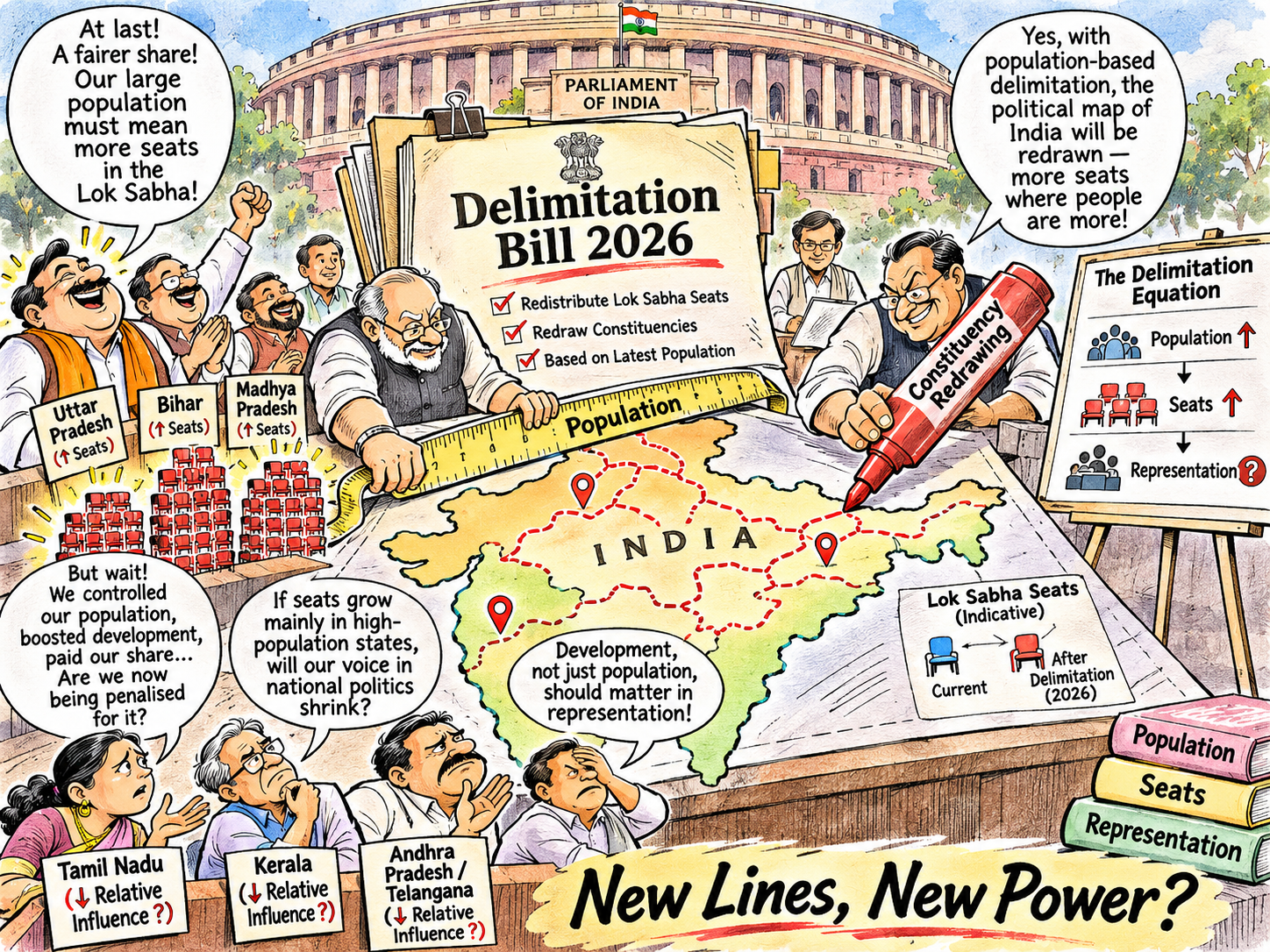
India's demographic transition has not occurred at the same speed everywhere. Many southern states experienced fertility decline earlier than several northern states. A purely population-based redistribution could therefore reduce the relative parliamentary weight of some states even if their absolute number of seats did not decline.
Supporters of a population-based approach emphasise political equality: citizens should ideally have comparable representation irrespective of where they live. Supporters of a continued freeze argue that successful population stabilisation should not translate into diminished influence within the Union.
Both positions address genuine democratic concerns. They differ in how they balance individual representation, regional interests and incentives for long-term public policy. The revised proposal is an attempt to maintain existing interstate proportions while expanding representation. Whether that compromise remains fair over another generation is a separate question.
What does this mean for women's reservation?
The Constitution (106th Amendment) Act, 2023 established reservation of approximately one-third of seats for women in the Lok Sabha, state legislative assemblies and Delhi's Assembly. It also provides for women's reservation within seats reserved for Scheduled Castes and Scheduled Tribes.
The 2023 amendment tied implementation to a delimitation exercise after publication of the relevant figures from the first census following its commencement. The revised 2026 package seeks to accelerate implementation, with the government targeting the 2029 general election. [3][4][5]
Expanding the House is one proposed method of accommodating women's reservation. It is not a mathematical necessity: a one-third reservation could also be applied within an existing House if the constitutional and statutory framework were changed accordingly. The choice between expansion and reservation within existing strength involves political and institutional considerations.
What about Scheduled Castes, Scheduled Tribes and OBC representation?
Articles 330 and 332 govern SC and ST reservation in the Lok Sabha and state assemblies. The revised proposal would update the census basis for these allocations and maintain it until 2051, according to the circulated amendment as reported on 29 November. Government sources have also projected an increase in reserved seats. Final category-wise numbers should be checked against enacted legislation and official commission orders.
Opposition parties have questioned whether the package adequately safeguards SC and ST representation. Some parties have also called for specific representation of OBC women. These are distinct issues: a reservation for women within existing SC/ST seats is not the same as establishing a separate OBC legislative quota. [4][6]
Who would draw the new boundaries?
The official withdrawal statement explains that the proposed replacement legislation envisages a Delimitation Commission constituted following commencement of the law. It would undertake seat readjustment under the revised framework and use the latest published census figures for territorial boundaries. As of the date of this article, 2011 remains the latest completed census with published population figures.
A sound boundary exercise requires transparent population data, consistent treatment of geographical features and administrative boundaries, public consultation and clear explanations of decisions. A technically lawful map can still be controversial if communities believe they have been divided or combined unfairly.
Gerrymandering refers to drawing electoral boundaries to advantage a political group. It is a risk worth guarding against, not a conclusion that can be drawn merely from the existence of a delimitation proposal.
Why do political parties disagree?
The government argues that the revised formula responds to regional concerns while increasing representation and implementing women's reservation. Several regional parties, including the BRS, have welcomed the proportional expansion. Reports also describe support from the DMK, which had opposed the earlier approach.
Congress and several INDIA bloc parties have opposed the revised package, favouring implementation of women's reservation within the current House and raising questions about the justification for expansion, minority representation and safeguards for boundary drawing. [6][7][8]
Political statements should be read as stated positions, not as proof that every predicted benefit or harm will occur. Parties may also revise their positions during parliamentary negotiations.
How does a constitutional amendment become law?
Under Article 368, the amendment must pass each House separately with a majority of its total membership and at least two-thirds of members present and voting. Amendments affecting specified federal provisions, including representation of states in Parliament, additionally require ratification by at least half the state legislatures before presidential assent.
Cabinet approval, introduction, parliamentary passage, state ratification where required, assent and commencement are distinct stages. A proposal does not change constituencies merely because it is announced. The commission's subsequent work is also separate from the legislative process.
What should citizens watch next?
- Whether Parliament adopts the proposed proportional increase and the precise rounding method.
- Which census reference is established in the final legislation.
- The timeline for women's reservation and the treatment of existing reserved constituencies.
- How the commission is constituted and how its draft boundaries are reviewed.
- Whether state ratification and implementation proceed as required.
- The administrative and financial implications of a larger Parliament and state assemblies.
Final thoughts
Delimitation is not simply a question of adding seats. It concerns the relationship between citizens, representatives, regions and institutions. The revised November proposal attempts to combine a larger legislature, earlier women's representation and protection of existing interstate political proportions.
Its merits should be assessed against the actual legislative text, transparent boundary procedures and measurable representation outcomes, rather than party slogans alone. A durable democratic settlement must consider both the voice of individual citizens and the confidence of India's diverse states in the federal system.
References and further reading
- [1] Lok Sabha — Official statement of reasons for withdrawal of the original Delimitation Bill, 27 November 2026
- [2] PRS Legislative Research — April constitutional amendment and delimitation package
- [3] The Indian Express — Revised provisions and interstate seat freeze, 28 November 2026
- [4] Akashvani — Government estimates and proposed legislative timetable, 29 November 2026
- [5] Constitution (106th Amendment) Act, 2023 — Text of women's reservation provisions
- [6] The Indian Express — Comparison of the April and November proposals, 29 November 2026
- [7] The Indian Express — BRS support for revised proposal, 29 November 2026
- [8] The Tribune — Opposition response, 29 November 2026
- Legislative Department — Constitution of India
- Akashvani — Scheduled introduction of the revised legislative package
Editorial note: This explainer reflects information available on 29 November 2026, before the scheduled introduction. Illustrative seat calculations are not official allocations. Update the legislative status and final provisions before publication if parliamentary proceedings have occurred.