
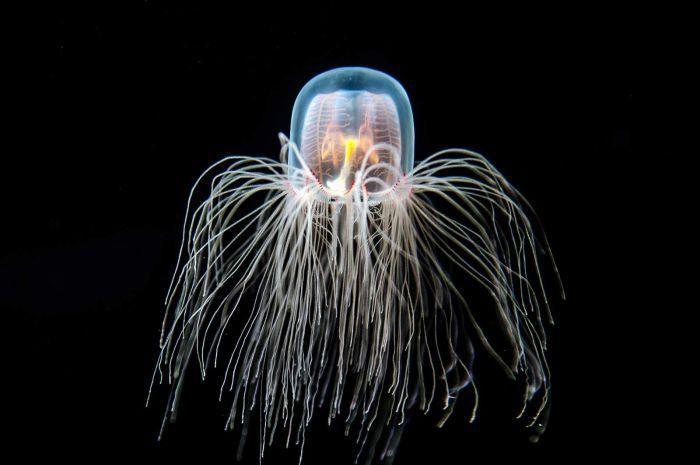
The Immortal Jellyfish: The Tiny Animal That Can Reverse Its Age
Imagine growing old and then, instead of dying from ageing, returning to an earlier stage of life.
Your adult body transforms, your tissues reorganise, and you begin developing again.
It sounds like a concept from science fiction.
Yet in the oceans, a tiny transparent animal possesses a remarkable ability that resembles this extraordinary scenario.
Its scientific name is Turritopsis dohrnii, commonly known as the immortal jellyfish.
Unlike most animals, this jellyfish can reverse its developmental life cycle, potentially repeating the process multiple times.
But does that mean it can truly live forever?
And could studying this unusual creature help scientists understand human ageing?
Meet the Immortal Jellyfish
Turritopsis dohrnii is a small hydrozoan belonging to the phylum Cnidaria, a group that includes jellyfish, corals and sea anemones.
The adult jellyfish is approximately 4–5 millimetres in diameter, making it smaller than a typical human fingernail.
Its body is nearly transparent, with a delicate bell-shaped structure and fine tentacles extending around its margin.
Despite its tiny size, it possesses one of the most unusual developmental abilities known in the animal kingdom.
| Feature | Description |
|---|---|
| Scientific name | Turritopsis dohrnii |
| Common name | Immortal jellyfish |
| Phylum | Cnidaria |
| Class | Hydrozoa |
| Approximate adult size | 4–5 millimetres |
| Habitat | Marine environments |
| Special ability | Reversal from medusa to polyp stage |
| Biological significance | Regeneration, cellular plasticity and ageing research |
The Normal Life Cycle of a Jellyfish
To understand why this jellyfish is special, we first need to understand how many hydrozoan jellyfish normally develop.
The typical life cycle includes several stages.
1. Fertilised Egg
Sexual reproduction produces a fertilised egg, which develops into an embryo.
2. Planula Larva
The embryo develops into a small, swimming larva called a planula.
The planula eventually settles on a suitable surface.
3. Polyp Stage
After settlement, the organism develops into a polyp.
A polyp is generally attached to a surface and can reproduce asexually, producing additional polyps or new jellyfish.
4. Medusa Stage
The medusa is the familiar free-swimming jellyfish form.
It develops reproductive structures and may reproduce sexually.
In most jellyfish, the adult medusa does not naturally return to its juvenile polyp form as part of the normal reproductive cycle.
However, Turritopsis dohrnii can follow an extraordinary alternative pathway.
How Does the Immortal Jellyfish Reverse Its Age?
When the adult jellyfish experiences certain stressful conditions, such as physical damage or starvation, it may undergo a process known as life-cycle reversal.
Instead of continuing along the usual developmental pathway, the medusa begins transforming.
Its tentacles retract, its body contracts, and it loses its characteristic swimming form.
It may settle onto a surface as a cyst-like structure.
The tissues subsequently reorganise and develop into a new polyp.
This polyp can eventually produce new medusae, allowing the developmental cycle to begin again.
The process can be represented as:
Normal development:
Egg → Planula larva → Polyp → Medusa
Reverse development:
Medusa → Cyst-like stage → Polyp → New medusae
The animal is not literally becoming a younger adult jellyfish.
Instead, it is returning to a developmentally earlier body form.
This distinction is important.
The Secret Behind Its Transformation: Cellular Reprogramming
One of the most fascinating aspects of the immortal jellyfish is the way its cells change during reverse development.
Most cells in the human body become specialised for particular functions.
For example:
- Muscle cells are specialised for contraction.
- Nerve cells transmit electrical and chemical signals.
- Red blood cells transport respiratory gases.
- Epithelial cells form protective and functional tissue layers.
During ordinary human development, cells progressively acquire specialised identities.
Reversing these identities is biologically challenging.
However, Turritopsis dohrnii demonstrates an extraordinary degree of cellular plasticity.
What Is Transdifferentiation?
Transdifferentiation occurs when a differentiated cell changes into another differentiated cell type.
Research on the immortal jellyfish indicates that cellular reprogramming and transdifferentiation are involved in its reverse development.
These mechanisms allow tissues to reorganise into structures appropriate for the polyp stage.
However, the transformation is complex, and scientists are still investigating which cellular pathways control each part of the process.
What Have Scientists Discovered About Its Genes?
In 2022, researchers published a comparative genomic study examining Turritopsis dohrnii and a related jellyfish, Turritopsis rubra.
The investigation identified differences involving several biological processes associated with cell survival, tissue maintenance and developmental plasticity.
Important areas included:
1. DNA Repair
DNA is continually exposed to damage from normal cellular processes and environmental influences.
Cells possess molecular mechanisms that identify and repair many forms of genetic damage.
The genomic study identified potentially important differences involving genes associated with DNA replication and repair.
These findings may help researchers investigate how the jellyfish maintains its cellular functions during repeated developmental transformations.
2. Telomere Maintenance
Telomeres are specialised structures at the ends of chromosomes.
They help protect chromosome integrity and are closely connected to cellular ageing and replication.
Researchers identified differences involving genes associated with telomere maintenance.
However, this does not establish that the jellyfish possesses an unlimited ability to maintain telomeres or that telomere regulation alone explains its rejuvenation.
3. Cellular Reprogramming
Cells undergoing developmental transformation must alter patterns of gene expression.
Researchers identified changes associated with pathways controlling developmental identity and cellular plasticity.
These findings suggest that coordinated changes in gene regulation are important during the return from medusa to polyp.
4. Oxidative Stress and Cellular Maintenance
Reactive oxygen species are produced during normal metabolism and may damage cellular components when their production exceeds protective mechanisms.
The comparative study also highlighted genes associated with the cellular redox environment and mechanisms involved in maintaining cellular integrity.
Together, these discoveries suggest that rejuvenation involves multiple interacting biological pathways rather than a single extraordinary gene.
Is the Immortal Jellyfish Really Immortal?
The answer depends on what we mean by immortality.
Scientists sometimes use the term biological immortality to describe organisms that appear capable of avoiding the usual irreversible progression towards death from ageing.
The immortal jellyfish may repeatedly return to an earlier life stage under favourable conditions.
However, this does not make the animal indestructible.
It can still die from:
- Predation.
- Disease.
- Environmental changes.
- Physical injury.
- Unfavourable conditions that prevent successful recovery.
Furthermore, the precise maximum lifespan of an individual jellyfish in nature remains unknown.
Its capacity for repeated life-cycle reversal has been demonstrated experimentally, but an unlimited lifespan has not been established.
The scientifically accurate conclusion is that the immortal jellyfish possesses an unusual potential for repeated developmental rejuvenation, not proven immunity from death.
Why Is This Discovery Important for Human Medicine?
Ageing is a complex biological process involving progressive changes in cellular and tissue function.
It is associated with mechanisms such as:
- Genomic instability.
- Telomere attrition.
- Epigenetic alterations.
- Loss of proteostasis.
- Cellular senescence.
- Stem-cell dysfunction.
- Chronic inflammation.
Researchers studying ageing are interested in how organisms maintain cellular integrity, repair damage and regenerate tissues.
The immortal jellyfish provides an unusual natural model for investigating these processes.
Could It Help Us Understand Regenerative Medicine?
Regenerative medicine aims to restore or replace damaged cells, tissues and organs.
The ability of Turritopsis dohrnii to reorganise tissues and alter cellular identities may offer valuable insights into how developmental programmes can be reactivated.
However, understanding this process in a jellyfish does not mean that the same transformation can be safely reproduced in humans.
Human organs, cellular organisation and developmental regulation differ substantially from those of cnidarians.
Could Humans Become Biologically Immortal?
At present, there is no scientific evidence that studying this jellyfish can make humans immortal.
Research into cellular reprogramming has potential applications, but major challenges remain.
Uncontrolled cellular proliferation and inappropriate reprogramming can cause serious problems, including abnormal tissue formation and tumour development.
The medical value of the research lies in improving our understanding of biological mechanisms, not in promising an imminent cure for ageing.
How Does It Compare with Other Long-Lived Animals?
The immortal jellyfish is not the only organism that challenges our understanding of ageing and longevity.
| Animal | Remarkable Characteristic |
|---|---|
| Immortal jellyfish | Can reverse its developmental life cycle |
| Hydra | Exhibits extensive regenerative capacity and negligible senescence under some experimental conditions |
| Greenland shark | Exceptionally long lifespan, potentially spanning several centuries |
| Ocean quahog clam | Some individuals can live for more than 500 years |
| Tardigrade | Can survive certain extreme conditions through cryptobiosis, but is not immortal |
These animals employ very different biological strategies.
Exceptional longevity, resistance to environmental stress and developmental rejuvenation should not be confused with one another.
Five Fascinating Facts About the Immortal Jellyfish
- It is only a few millimetres across.
- It can transform from an adult medusa into a juvenile polyp stage.
- Its reverse development involves substantial cellular reorganisation.
- Researchers have studied its genome to investigate mechanisms associated with rejuvenation.
- It can still die despite being popularly described as immortal.
What Does the Immortal Jellyfish Teach Us?
For centuries, humans have imagined immortality as the ability to escape ageing and death.
The immortal jellyfish offers a more surprising biological possibility.
In this animal, development is not necessarily a one-way journey.
Under certain circumstances, an adult body can return to an earlier stage and generate a new developmental cycle.
This challenges the assumption that all animal development must always proceed irreversibly from youth to adulthood.
It also raises fascinating questions about cellular identity, regeneration and the evolution of ageing.
Final Thoughts
One of nature's most remarkable biological abilities belongs not to a giant or powerful creature, but to a jellyfish barely visible to the naked eye.
Its ability to reverse development does not make it invulnerable, nor does it provide a ready-made solution to human ageing.
Instead, it offers scientists a rare opportunity to investigate how cells and tissues can reorganise themselves.
Perhaps the greatest lesson of the immortal jellyfish is that biology contains possibilities far stranger than we once imagined.
Sometimes, the most extraordinary discoveries come from the smallest creatures.
References and Further Reading
- Natural History Museum — Immortal Jellyfish: The Secret to Cheating Death
- Comparative Genomics of Mortal and Immortal Cnidarians Unveils Novel Keys Behind Rejuvenation (2022)
- Cellular Reprogramming and Immortality: Expression Profiling Reveals Putative Genes Involved in Turritopsis dohrnii's Life Cycle Reversal (2021)
- Genome Assembly and Transcriptomic Analyses of the Repeatedly Rejuvenating Jellyfish Turritopsis dohrnii (2023)
- Institute of Marine Sciences — The Immortal Jellyfish