Inside Gen Z: How AI and Social Media Are Changing Learning, Relationships and Work
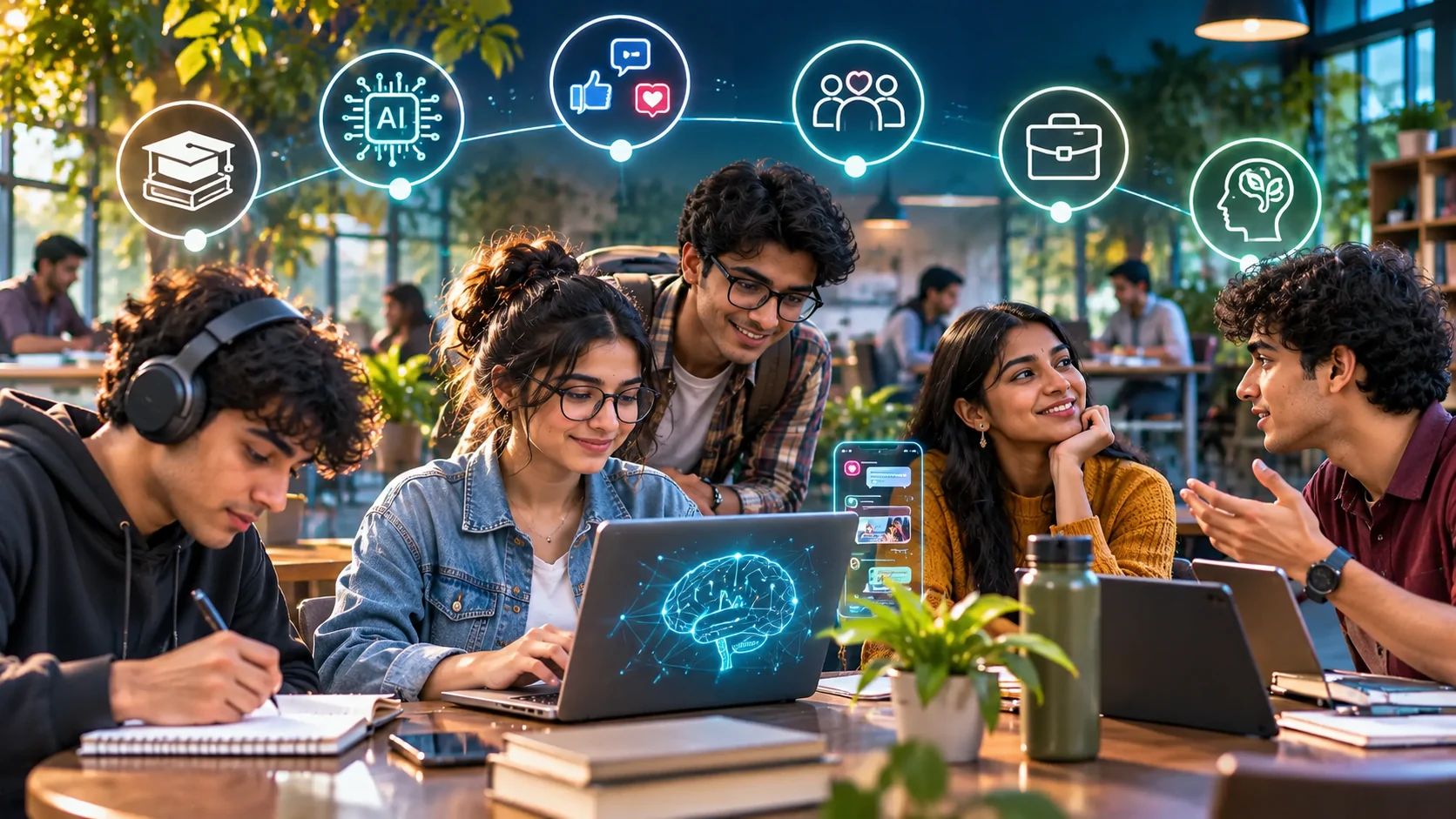
A student asks an AI assistant to explain a difficult concept. A young professional uses the same technology to prepare a presentation. Between those tasks, messages arrive, short videos compete for attention and friends share news through social feeds. These routines are becoming ordinary for many young people—but they contain a remarkable question: what happens when education, friendship and employment are all reshaped at once by digital platforms and artificial intelligence?
Generation Z is often described as the first generation to grow up with smartphones and social media. In 2026, a second transformation is underway: AI assistants are joining search engines, messaging apps and classrooms. The results are neither entirely liberating nor uniformly harmful. Research increasingly reveals a mixture of new opportunities, new pressures and considerable variation among young people.
Who counts as Generation Z?
A commonly used convention places Generation Z births from 1997 to 2012, following millennials, although researchers and organisations use different cutoffs. A generation is a broad historical cohort, not a diagnosis or a fixed personality type. An Indian college student, a rural apprentice, a young American office worker and a teenager without reliable internet may all belong to the same birth cohort but experience technology very differently.
To understand Gen Z, it is more useful to ask what technologies and institutions shape their lives than to assume everyone shares the same attitudes.
1. AI is becoming an everyday learning assistant
Consider two ways a student might use a chatbot. In the first, the student asks for a ready-made answer and submits it without understanding. In the second, the student asks for a simpler explanation, requests practice questions, checks the output against a textbook and then solves the problem independently. Both interactions involve AI; only one deliberately develops the student's knowledge.
A Pew Research Center survey of 1,458 US teenagers aged 13–17, conducted in September–October 2025 and published in February 2026, found that 57% had used AI chatbots to search for information and 54% for schoolwork help. The findings show how familiar these tools have become among American teenagers, not how frequently all Gen Z students worldwide use them. [1]
AI can help with translation, explanations at different difficulty levels, flashcards, language practice, feedback on drafts and examples tailored to a learner's questions. But it can also produce convincing errors, fabricated references and confident explanations that conceal uncertainty.
2. Learning faster is not always learning better
AI makes it easier to finish an assignment. That is not the same as gaining the knowledge needed to complete a similar task unaided. This distinction matters in medicine, engineering, law and every field where independent reasoning is essential.
Potential benefits include quicker feedback, accessibility for learners who struggle with conventional explanations and the ability to practise without embarrassment. Potential costs include less retrieval practice, shallow understanding, dependence on generated answers and weaker source-checking habits. These are plausible mechanisms and educational concerns; they should not be mistaken for proof that AI has damaged an entire generation's intelligence.
A practical AI-assisted learning cycle is: attempt the problem first; ask the tool to explain a difficult step; compare its response with a reliable source; answer a similar question without assistance; and record what was learned. The aim is to make AI a tutor, not a substitute for thinking.
3. Social media is both a meeting place and an attention economy
For many young people, social platforms are not merely entertainment. They are where friendships are maintained, cultural trends spread, artists find an audience, job opportunities circulate and communities organise. They can be particularly valuable to someone who feels isolated locally or is searching for people with similar interests.
Yet these services also compete for attention through recommendations, notifications, infinite feeds and highly personalised content. A person may open an app to answer one message and emerge much later after viewing dozens of unrelated posts. The design of the environment—not merely an individual's willpower—helps determine how easy or difficult it is to disengage.
Pew's 2025 report on US teenagers found that 74% felt social media helped them feel more connected with friends and 63% said it offered a place to express creativity. But 45% said it hurt their sleep and 40% said it hurt their productivity. [2] Both sets of findings can be true at the same time.
4. Friendships, identity and the pressure to be visible
Online communication helps relationships continue across schools, cities and countries. Group chats provide support, while shared videos and memes become a kind of everyday social language. But visible popularity metrics, carefully curated photographs and comparison with strangers can also make ordinary lives appear inadequate.
A useful distinction is between active connection—talking meaningfully with friends or creating something together—and passive comparison, such as endlessly scrolling through idealised images. Neither activity is automatically good or bad, but their effects can differ depending on the person and circumstances.
The same Pew survey found that 39% of US teenagers reported feeling overwhelmed by drama on social platforms, while 31% experienced pressure to post popular content. These are self-reported experiences, not evidence that every user is harmed. [2]
5. Can an AI chatbot become a friend?
AI companionship introduces a genuinely new dimension. A chatbot can respond immediately, sound patient, remember conversational context within its capabilities and simulate empathy. For someone who is lonely or nervous about expressing feelings, this may make conversation seem unusually easy.
In a 2025 US survey of teenagers, Common Sense Media reported that nearly three in four had tried AI companions, with about half using them regularly. Its report raised concerns about privacy, emotional dependence and substituting simulated responses for human relationships. This study concerns AI companions, a category not identical to every educational or general-purpose chatbot. [3]
AI can help someone rehearse a difficult conversation or organise thoughts. But it is not a human friend, does not share human responsibilities and should not replace trusted people or qualified mental-health care. Users should also avoid sharing intimate details that they would not want stored or processed by a technology service.
6. What about anxiety, depression and attention?
Research into social media and mental health is complicated. A person experiencing distress may spend more time online; certain online experiences may worsen distress; and offline factors such as family conflict, economic insecurity, bullying and sleep loss can affect both. A survey showing an association does not prove that an app caused a disorder.
In Pew's 2025 US teen survey, 19% said social media hurt their mental health, whereas about half described a neutral effect on their mental health. Girls were more likely than boys to report negative experiences in several areas. [2] These findings call for nuance rather than a claim that all young people are experiencing the same digital crisis.
Practical safeguards include protecting sleep, turning off unnecessary notifications, creating periods of uninterrupted work, taking breaks from accounts that provoke persistent comparison, and seeking professional support when symptoms persist or interfere with daily life.
7. How AI is changing work for Gen Z
The workplace presents another contradiction. AI tools can reduce routine work, help generate drafts, analyse data and enable rapid experimentation. At the same time, young employees worry that entry-level tasks traditionally used to learn a profession may be automated.
Deloitte's global 2026 Gen Z and Millennial Survey reported widespread workplace AI use and growing interest in using AI for learning, career guidance and coping with work-related stress. Survey responses describe how participants use tools and perceive their workplace; they do not establish that AI guarantees promotions or eliminates jobs. [4]
Deloitte's India-specific 2026 findings reported that 93% of surveyed Indian Gen Z respondents used AI in day-to-day work. This is a result from a survey of working respondents, not 93% of all Indian Gen Z people, many of whom are students, outside formal employment or have limited internet access. [5]
The key advantage in a changing labour market may be the ability to combine AI literacy with domain knowledge, communication, ethical judgment and the capacity to verify results. Knowing how to prompt a tool is useful; knowing whether its output is correct is often more valuable.
8. Does Gen Z really reject traditional careers?
Popular commentary often portrays young workers as uninterested in ambition, unwilling to commit or obsessed with flexibility. Research paints a less simplistic picture. Deloitte's 2026 findings describe concerns about financial stability, living costs, skill development and sustainable progress. Many participants want advancement, but not necessarily through a single traditional career ladder. [4]
Economic context matters. A graduate facing high living costs, competitive recruitment and changing hiring practices may prioritise practical skills and job security. That behaviour does not need to be explained by generational stereotypes alone.
What current research tells us
| Research finding | What it suggests | Important limitation |
|---|---|---|
| 57% of surveyed US teens had used chatbots for information; 54% for schoolwork [1] | AI is embedded in many teenagers' information habits | US ages 13–17, not all of Gen Z |
| 74% felt more connected to friends via social media [2] | Online platforms can support relationships | Self-reported perception, not measured friendship quality |
| 45% reported social media hurt their sleep [2] | Late or intensive use can be a practical concern | Does not prove causality for each person |
| Nearly three in four surveyed teens had tried AI companions [3] | Simulated social interaction is gaining traction | Companion apps differ from educational chatbots |
| 93% of surveyed working Indian Gen Z respondents used AI at work [5] | AI is prominent in the surveyed professional population | Cannot be generalised to all Indian young people |
What students, parents and employers can do
Students: use AI to test understanding rather than bypass it; check citations; learn to recognise manipulated images and fabricated material; keep offline friendships, exercise and sleep in the schedule.
Parents and educators: ask what young people are actually doing online instead of treating all screen time as identical. Teach privacy, verification, self-regulation and healthy boundaries. Recognise that social networks can support belonging as well as expose users to harm.
Employers: teach practical AI use alongside data protection, feedback, collaboration and professional judgment. Offer meaningful entry-level learning so automation does not remove every opportunity to develop foundational skills.
Conclusion: a generation negotiating two revolutions
Generation Z is not simply the 'phone generation' or the 'AI generation'. Its members are navigating a world in which tools for knowledge, social connection and professional work are changing unusually quickly. Technology can reduce barriers to education and amplify creativity, while also introducing risks involving distraction, misinformation, surveillance and social dependence.
The more useful question is not whether Gen Z is better or worse than older generations. It is which skills, relationships and institutions will help young people use powerful technologies without losing independent thought and human connection.
References and further reading
- [1] Pew Research Center (2026), How Teens Use and View AI: https://www.pewresearch.org/internet/2026/02/24/how-teens-use-and-view-ai/
- [2] Pew Research Center (2025), Social Media and Teens' Mental Health: https://www.pewresearch.org/internet/2025/04/22/teens-social-media-and-mental-health/
- [3] Common Sense Media (2025), Talk, Trust, and Trade-Offs: https://about.commonsensemedia.org/research/reports/talk-trust-and-trade-offs-how-and-why-teens-use-ai-companions
- [4] Deloitte (2026), Gen Z and Millennial Workforce Trends: https://www.deloitte.com/global/en/insights/topics/talent/gen-z-and-millennial-workforce-trends.html
- [5] Deloitte India (2026), Gen Z and Millennial Survey: https://www.deloitte.com/in/en/issues/work/genz-millenial-survey-india-2026.html