The Man Who Spent 22 Years Cutting a Road Through a Mountain
Imagine seeing a wall of rock between your village and the wider world. Imagine having no construction company, no heavy machinery and no public works budget. Then imagine deciding to carve a route through that obstacle with little more than a hammer and chisel.
That is the achievement for which Dashrath Manjhi, a labourer from Gehlaur in Bihar's Gaya district, became known as India's *Mountain Man*. He worked for roughly 22 years, from 1960 to 1982, to open a passage through a rocky hill.
It is tempting to treat the story as a fable. But Manjhi was a real person, and the passage associated with his work became part of the region's physical landscape.
A village divided by rock
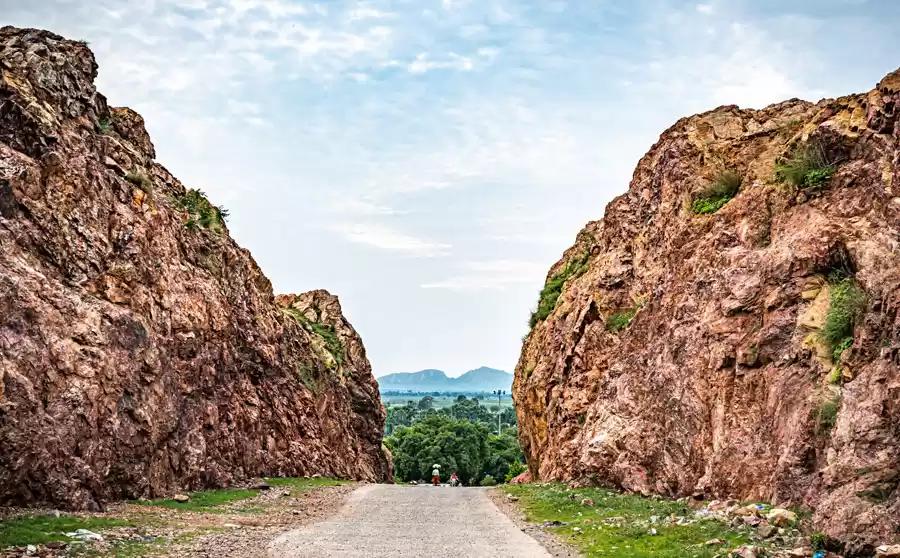
For people living in and around Gehlaur, a ridge created a serious barrier to travel. Getting to markets, schools and medical facilities could involve a much longer route around the hill.
Accounts of Manjhi's motivation centre on the death of his wife, Falguni Devi, and the difficulty of obtaining timely help. Retellings differ in details of the accident, illness and sequence of events; the better-supported general picture is that family tragedy and the lack of accessible transport inspired his resolve to create a shorter passage.
A hammer, a chisel and years of labour
Beginning around 1960, Manjhi repeatedly struck and removed rock. He did this without the machinery normally used to cut a road through a hill. The work progressed slowly, over seasons and years, long enough that neighbours reportedly questioned whether it would ever succeed.
The finished passage has been variously described in reports as about 100–110 metres long and several metres wide. Published accounts also disagree about exactly how much the route shortened local journeys. What is not in serious dispute is the physical achievement: he created an accessible way through an obstacle that had long separated communities.
The difference between persistence and infrastructure
The popular version of Manjhi's life is sometimes told as proof that a single person can solve any problem by trying hard enough. His story deserves more careful attention.
His persistence was exceptional. But the need for such persistence also raises uncomfortable questions. Why should a villager have to devote decades of his life to a path that public infrastructure might have provided? Why were essential journeys so difficult in the first place?
The same passage can therefore be read in two ways: a monument to human determination and a reminder of the cost of public neglect.
Why the story still matters
| What Manjhi achieved | Why it matters |
|---|---|
| Cut a passage through a rocky ridge | Improved physical connectivity between communities |
| Continued work over about 22 years | Demonstrated unusual persistence under difficult conditions |
| Drew attention to isolated villages | Highlighted transport barriers to healthcare, education and livelihoods |
| Became a symbol of rural determination | Raised lasting questions about infrastructure and public responsibility |
Beyond the legend
Manjhi died in 2007. His life later inspired books, documentaries and the 2015 Hindi feature film Manjhi: The Mountain Man. But screen portrayals dramatise events; they are not substitutes for historical reporting.
Even decades after the path was carved, journalists reporting from his region have noted that local problems did not disappear. That is an important part of the legacy. One person's heroism can change a landscape without eliminating the wider inequalities that shaped it.
The lesson in the mountain
A mountain is a dramatic obstacle because everyone can see it. Barriers created by poverty, social exclusion, inadequate roads and poor access to care are less visible, yet they can be just as formidable.
Dashrath Manjhi broke through literal rock. His story asks what societies are willing to do about the barriers that remain.
Sources and reporting notes
- National Institute of Disaster Management — account of Manjhi's road-building effort
- Civil Society Magazine — reporting from Gehlaur and continuing challenges
- The Telegraph — passage dimensions and the biographical film
- India Today — biographical overview
Editorial note: Retellings vary in their precise distances and the circumstances of Falguni Devi's death. The featured illustration is not an archival photograph.