The High-IQ Mind: Common Traits, Famous Examples and Books Worth Reading
Does a highly intelligent person always remember everything, speak brilliantly, solve equations instantly and succeed in life? Popular portrayals of genius suggest so. Psychological research offers a more interesting answer: intelligence is measurable in certain domains, but no single personality, appearance or life story defines a high-IQ person.
Some people with exceptionally strong reasoning ability are curious and academically accomplished. Others are quiet, unconventional or intensely focused on one narrow interest. Intelligence does not guarantee wisdom, creativity, empathy or good decisions. Understanding these distinctions is more useful than collecting spectacular IQ numbers from the internet.
What Is IQ, and What Does It Measure?
An intelligence quotient (IQ) is a score from a standardised assessment of cognitive abilities, often including abstract reasoning, verbal comprehension, visual-spatial analysis, working memory and processing speed. Many modern tests are normed to an average of 100 and a standard deviation of 15; under that convention, scores around 130 are about two standard deviations above the mean. Interpretation depends on test quality, age, measurement error, language, culture, and the context of assessment.
A score is not a person's total value. It does not directly measure honesty, compassion, artistic taste, perseverance, practical judgment or every kind of talent. Nor can a reliable adult IQ be inferred from a school grade, chess rating, job title or a person's fame.
Qualities Often Associated With Strong Cognitive Ability
1. Comfort With Complex Patterns
Reasoning tests often assess the ability to find relationships in unfamiliar material. Someone with high reasoning ability may recognise structure in equations, arguments, data, language or visual designs relatively quickly. That does not mean being equally skilled in every subject.
2. Intellectual Curiosity
Research on personality and intelligence finds positive associations particularly for intellectual engagement, interest in ideas and some aspects of openness to experience. These are statistical trends across groups, not universal personality requirements. A high-IQ person can still be uninterested in a subject, while someone without an exceptional test score may be deeply curious.
3. Rapid Learning in Strong Domains
Some individuals learn abstract concepts quickly or require fewer examples. However, prior knowledge, teaching quality, practice and motivation still matter greatly. Cognitive ability and learned expertise are related but not interchangeable.
4. Ability to Handle More Than One Constraint
Complex problems can require holding competing possibilities in mind, checking assumptions and revising plans. Working memory and executive functions contribute, although their relationships with overall intelligence are not identical or unlimited.
5. Reflective Questioning — Sometimes
A capable thinker may ask what evidence would disprove a claim or whether an apparently obvious answer is misleading. But intelligence does not automatically protect against motivated reasoning or overconfidence. Intelligent people can defend a poor decision with surprisingly sophisticated arguments.
6. Uneven Strengths
A person may excel in mathematical reasoning but have average verbal skills, or show the reverse pattern. Even an unusually high overall score can hide a more varied profile of strengths and challenges.
What Research Actually Shows
A large meta-analysis of personality and intelligence found that intellectual curiosity and related aspects of openness showed positive associations with cognitive ability, but many popular personality stereotypes were weak or inconsistent. High IQ is therefore not the same as introversion, social awkwardness, emotional coldness or arrogance.
Long-term research, including the Study of Mathematically Precocious Youth, has followed intellectually talented participants and explored how cognitive strengths, interests, educational opportunities and sustained effort contribute to later outcomes. It suggests that specialised ability and environmental support matter alongside broad intelligence. Other longitudinal work finds meaningful stability in cognitive abilities over time, especially after childhood, while also documenting individual variation.
Famous People: Achievement Is Stronger Evidence Than Viral IQ Numbers
Terence Tao — Mathematics
The Australian-American mathematician earned a doctorate at age 20, became a full professor at UCLA at 24 and won the Fields Medal in 2006. These achievements are well documented. Online claims placing his IQ at a precise extreme value are not equivalent to a publicly verified, comparable adult IQ assessment.
Marilyn vos Savant — Puzzles and Public Reasoning
The American columnist became famous through a historical Guinness listing for exceptional IQ and her 'Ask Marilyn' question-and-answer column. The old record used scoring conventions that should not be treated as directly comparable with modern IQ assessments; the highest-IQ record category was later discontinued. Her public work is a better topic of discussion than internet rankings.
Shakuntala Devi — Extraordinary Mental Calculation
India's Shakuntala Devi demonstrated an extraordinary calculation feat: Guinness World Records documents her multiplying two randomly chosen 13-digit numbers in 28 seconds at Imperial College London in 1980. This is evidence of exceptional calculation performance, not a measurement of general intelligence on a standard IQ test.
Albert Einstein — Scientific Creativity
Einstein transformed theoretical physics. Numbers such as 'Einstein's IQ was 160' circulate widely, but there is no reliable documented standardised IQ score to justify the precise claim. His theories, scientific arguments and intellectual persistence provide far stronger evidence of his contribution.
Myths Versus Evidence
| Common claim | Better understanding |
|---|---|
| All high-IQ people are geniuses at everything | Cognitive profiles differ, and expertise requires learning |
| High IQ guarantees wealth or happiness | Outcomes also depend on opportunity, health, judgement and circumstances |
| Introverted people necessarily have high IQ | Personality is not an IQ test |
| Smart people never make foolish decisions | Cognitive biases affect capable people too |
| Every famous scientist had an IQ over 160 | Most such historical numbers are speculative |
| High IQ and creativity are identical | They overlap in some ways but are distinct constructs |
Five Books Worth Reading About Intelligence
1. Intelligence: All That Matters — Stuart Ritchie (2015)
A concise introduction to the evidence, measurement, controversies and real-world meaning of intelligence. A suitable starting point for readers who want an accessible but research-oriented treatment.
2. The Neuroscience of Intelligence — Richard J. Haier
Explores what brain research can and cannot say about individual differences in cognitive ability. Useful for readers interested in neuroscience, methods and the limitations of drawing simple conclusions from brain scans.
3. The Intelligence Trap — David Robson (2019)
A book about why high cognitive ability does not guarantee rational judgement. It looks at biases, intellectual humility and the habits that help people think more wisely.
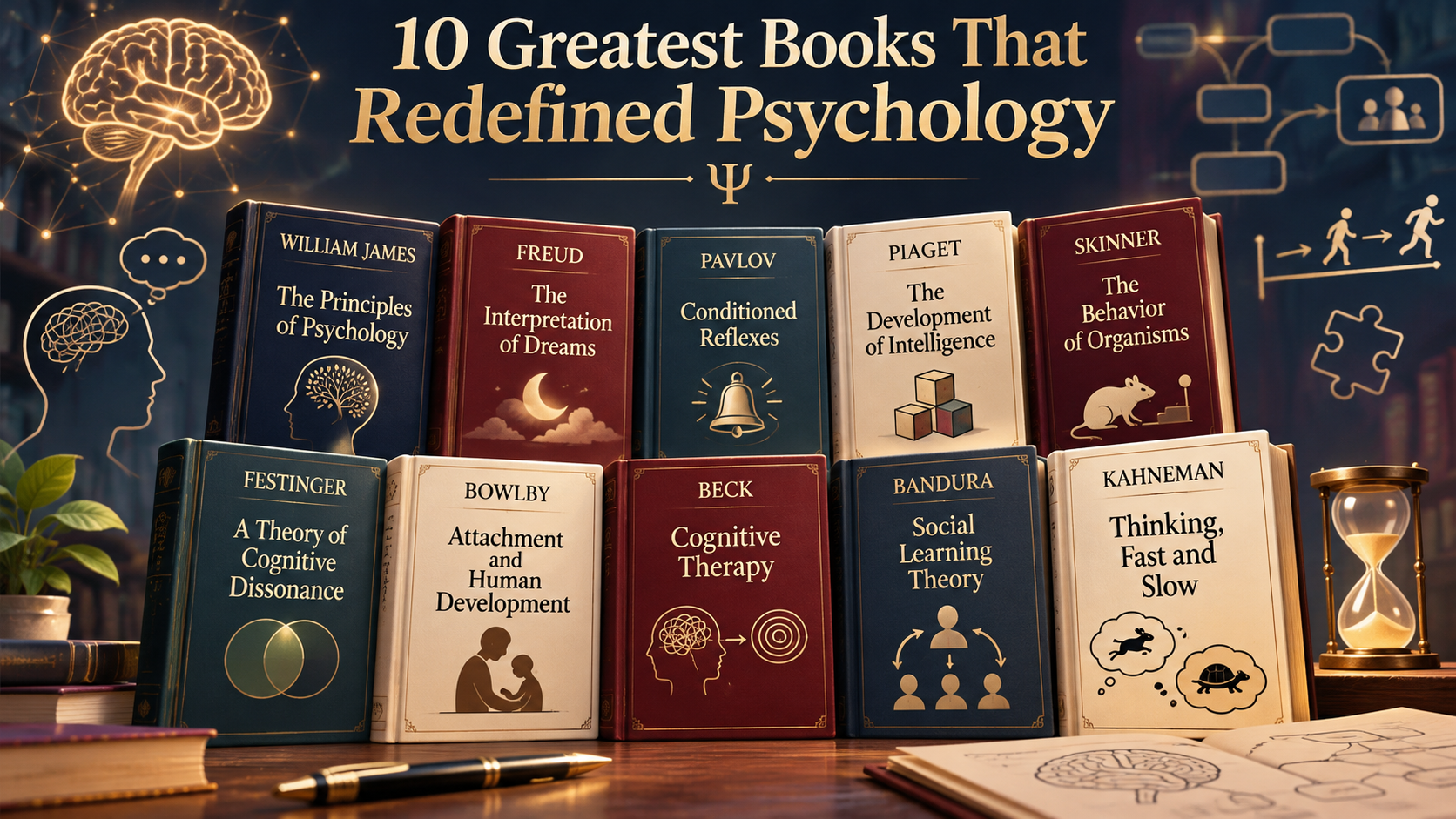
4. Thinking, Fast and Slow — Daniel Kahneman (2011)
A landmark introduction to intuitive and deliberative thinking, heuristics and biases. It is not an IQ handbook, and some research areas have faced replication challenges, but it remains useful for thinking critically about decision-making.
5. Successful Intelligence — Robert J. Sternberg (1996)
Argues for considering analytical, creative and practical abilities in understanding success. Treat it as an influential theoretical perspective rather than a replacement for all established psychometric research.
How Can We Develop Better Thinking?
Whatever someone's starting level, practical habits can help them learn and reason more effectively:
- Read arguments you disagree with and fairly restate the strongest opposing evidence.
- Study statistics, logic and the basics of scientific inference.
- Practise difficult skills with feedback, rather than relying on vague 'brain-training' promises.
- Build knowledge deeply in subjects that matter to you.
- Protect sleep and seek support when health problems affect attention or memory.
- Admit uncertainty and update beliefs when reliable evidence changes.
- Measure progress using real work, not social-media IQ quizzes.
These practices are valuable for learning and judgment; they should not be marketed as guaranteed methods of raising general IQ scores.
Conclusion
High IQ can help describe strong performance on selected cognitive tasks, but it is not a complete theory of a person. Curiosity, learning opportunities, deep work, ethical judgment and the ability to reconsider assumptions shape how intelligence is used. The more interesting question may be not 'Who has the biggest IQ number?' but 'What can a mind do responsibly with what it knows?'
Sources and Further Reading
- Meta-analysis of personality and intelligence
- Review of personality and cognitive ability
- Study of Mathematically Precocious Youth, review
- Cognitive ability stability meta-analysis
- UCLA, Terence Tao biography
- Guinness World Records, Shakuntala Devi
- Parade, Marilyn vos Savant biography
- Hachette, Intelligence: All That Matters
- Richard Haier, The Neuroscience of Intelligence
- David Robson, The Intelligence Trap
- Penguin, Thinking, Fast and Slow
- WorldCat, Successful Intelligence
Editorial note: This article is general psychology education. Cognitive test interpretation requires appropriately standardised instruments and qualified professional assessment where clinically relevant.